Do you remember the last wedding you went to as a guest?
You probably can’t remember the decorations. What you remember is how it felt: arriving, waiting between one part of the programme and the next, and leaving.
Some weddings look good. Others you feel. The first kind lives on in the footage. The second lives on in the people, and it comes through even on screen. The difference usually comes down to a few small decisions. Here are ideas from weddings abroad, from the night before to brunch the morning after, that you can work into your own day. For each one, we’ll tell you what your guests will feel and how to put your own spin on it.
The night before: rehearsal dinner and welcome party
The wedding is on Saturday, but on Friday night half your guests haven’t met the other half yet. Tomorrow they’ll be laughing and celebrating together. Tonight, they’re almost strangers.
In the US, the night before the wedding is often an event of its own, in one of two forms. The rehearsal dinner gets its name because the couple rehearses the ceremony and then everyone sits down to eat together. The welcome party is exactly what it sounds like. Either way, both sides get to know each other, and the couple thanks the people who helped make the wedding happen. It’s the opening act of a wedding weekend: dinner on Friday, wedding on Saturday, a relaxed brunch on Sunday. And it means guests arrive at the wedding among familiar faces.
Invite your closest people: your parents, your best man and maid of honour, the bridesmaids and groomsmen, and anyone travelling from another city or country. Hold the evening at the wedding venue or wherever guests are staying, so nobody has to travel further. Keep it relaxed: dinner, a barbecue, cocktails or just a glass of wine, with no programme and no speeches. The goal is to help people get to know each other, not to put on a second wedding.
Put photos of the two of you from different stages of your lives on the tables. Guests who haven’t met yet will have something to talk about and childhood stories to share. It’s an easy way to get the laughter started.
One long table for everyone
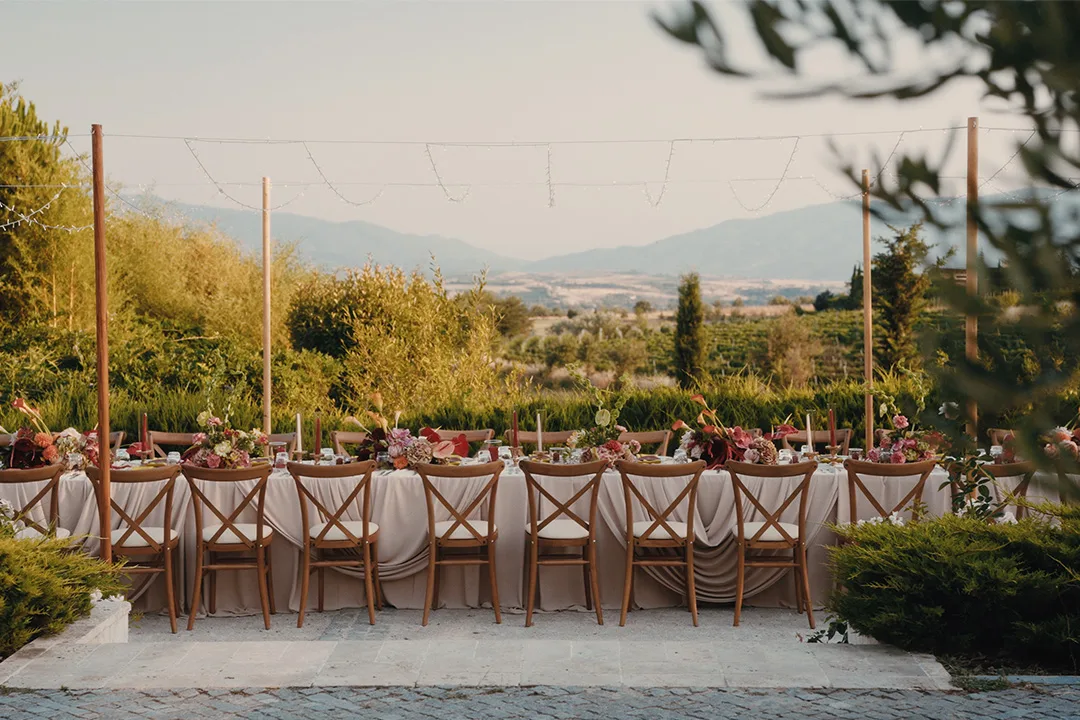
Picture walking into a reception and hunting for your table number on the seating chart. Relatives are at one table, colleagues at another, childhood friends at a third. Every table is its own little world. But there’s another way to seat your guests: put everyone at one table.
The idea comes from Italy, where the long table stands for family gatherings: Sunday lunches where several generations sit down together and nobody’s in a hurry. There’s even a saying, “you don’t grow old at the table,” the idea being that time spent around a table keeps you young. At weddings, it’s called the tavolo imperiale, the “imperial table”: one very long table for all the guests, or most of them, with the couple in the middle. Relatives, friends and colleagues end up talking across the table, not just to the people next to them. Everyone feels part of one gathering, rather than one of several small groups.
One table doesn’t make the question of who sits where disappear, but it does make it simpler. Keep families and couples close together, put your parents and your best man and maid of honour in prominent spots, and let everyone else sit where they like. With a large guest list, use two or three long tables instead of round ones.
Put a conversation card at each place setting, with a question like “Which dish takes you back to your family’s table?”.
A wedding that feels like home: lamps and a cosy corner
Somewhere between dinner and the dancing, some guests want to step away, sit down and talk. But there’s often nowhere quiet to go.
Weddings that feel like home are increasingly talked about in the US. That means lamps on the tables and a cosy corner with sofas, set up like a living room. Lamps are also a practical choice, since some venues don’t allow candles. The corner is a place to rest and chat. Guests feel at home rather than at an event.
Pick one or two of these ideas. Indoors: lamps on the tables and a corner with sofas. Outdoors: a rug, cushions and blankets under a tree or on the beach, plus LED lanterns or string lights. Put the corner where the music is softer, so people can hear each other.
Fill the corner with your favourite books or a photo album, so guests have something to leaf through while they take a break.
An unplugged ceremony
The ceremony begins, and the first few rows disappear behind a wall of raised phones.
“Unplugged weddings” are increasingly talked about in Italy. The idea is simple: when the couple says “I do,” everyone is watching them, not their own screens. Guests are fully present, living the moment, and they leave the footage to the professionals.
Put up a sign at the entrance to the ceremony, or ask whoever is leading the ceremony to remind everyone before it starts that it’s phone-free.
Write the sign in your own words, for example: “Be here with us. Put your phones away, please.” Then promise to send everyone the footage as soon as it’s ready.
A cocktail hour before dinner
The ceremony’s over, you are off taking photos, and the guests are standing outside with a glass in hand, waiting.
In France, the ceremony is followed by a vin d’honneur (“wine of honour”): a short reception with drinks and bites. In Italy, the equivalent is the aperitivo: a drink and something small to eat before everyone sits down. More and more couples add a station where guests mix or customise their own drinks. Either way, there’s time to talk between the ceremony and dinner. And with a station, guests have something to do together instead of just waiting. Guests feel welcomed before dinner even begins.
Plan for an hour to an hour and a half between the ceremony and dinner, while the two of you are having photos taken. Serve some bites, play light jazz and offer a non-alcoholic option, so there’s something for everyone. For a station, provide a base (sparkling wine, lemonade or tonic) and a few flavourings: fruit, herbs and syrups, and let guests build their own drinks. If the venue has no separate area for the cocktail hour, use the terrace or garden.
Name the cocktails after moments from your story: your first date, a favourite place, a song.
A dessert bar
Cutting the cake is a tradition, and guests look forward to it. But tastes differ: some love chocolate, others prefer fruit, and a few barely touch anything sweet.
In France, the wedding dessert is often a pièce montée, also known as a croquembouche: a tall tower of tiny profiteroles held together with caramel and served in front of the guests. In England, more and more couples add a dessert bar next to the cake: a table of brownies, cupcakes, tiramisu and sometimes a tower of macarons. The desserts double as decoration, and because guests choose for themselves, everyone finds something to their taste and feels you thought of them.
Keep the cake for the traditional cutting and put the bar next to it, so all the desserts are in one place. Order the desserts early from a pastry chef or bakery and ask for a tasting, so you can choose three or four that go well together. Small portions (macarons, mini cupcakes, profiteroles) work well: guests can pick them up with their fingers, and there’s less queuing.
Include one favourite dessert from each of you, with a little card next to it telling its story: “This is the taste of our first holiday.”
Something warm to eat at the end of the night
It’s well past midnight. The dance floor is still packed, but some guests are getting hungry, and dinner was hours ago.
In Spain, the party often carries on past the cake: around two or three in the morning, churros with hot chocolate appear. In England, late-night food has become a familiar part of the evening: hot sandwiches, taco trucks or an espresso martini bar, for the guests who stay until the end. In both places the idea is the same: something to eat keeps people there a little longer. The night doesn’t just stop; it winds down, and guests feel looked after right to the end.
Choose one thing and serve it once the dance floor starts to thin out, not earlier, so it doesn’t pull people away from the party. Mini pizzas or hot sandwiches work well. Small portions on trays, or at a separate table, are the easiest to serve. Check with the caterer that the kitchen works late and, if not, ask whether you can bring in an outside supplier.
Serve a dish from your first dinner together, or from the place where you met.
A farewell brunch the next day
The wedding’s over, guests are heading off in all directions, and you never got to say goodbye to half of them.
In France, the day after the wedding often has its own name, retour de noces (“the return after the wedding”): a brunch for guests the next morning. In the US, almost one in three weddings now lasts at least three days, so the morning after is often part of the celebration. Goodbyes at midnight tend to be rushed. In the morning, everyone’s calmer and has time to talk. Guests leave feeling they were part of your celebration, not just guests at an event.
Organize it around 11 a.m. at the same place or nearby, with no programme, and keep the menu simple: coffee, pastries, fruit and something warm. Keep it short, an hour or two, so it doesn’t wear anyone out. Include the brunch in the invitation and ask guests to RSVP, so you can give the venue a rough headcount. Have something ready for the road, such as a small bag of food or a coffee to go.
Leave a handwritten card at every place setting: “Thank you for being our guests!”.
The best shots in a wedding film are rarely the staged ones. They’re the laughter around the table, the hug at goodbye, the quiet conversation in the corner. These ideas are a way to make room for moments like those on your wedding day.